Why Does My Office Chair Roll on Hardwood Floors?

Time:2026-10-05 Author:Amelia
0%

An office chair can roll on hardwood floors because its casters are designed for easy movement. Smooth flooring offers little resistance, especially when the chair carries weight unevenly. A slight floor slope can also send the chair drifting across the room.

The problem is not always the chair itself. Hard plastic casters may slide, pivot, or bounce on a polished surface. Dust and fine grit can reduce control, while worn wheels may roll unpredictably. I once assumed a heavy chair would stay still, but that explanation was incomplete. The caster design mattered more than the chair’s weight.

This guide explains how to stop an office chair from rolling on hardwood floors using practical, floor-safe solutions. Options may include a non-slip chair mat, soft rubber casters, wheel brakes, or a more stable base. Each choice affects movement, noise, comfort, and the risk of scratching the finish. A mat with a textured underside can grip the floor, but an unsuitable plastic surface may still slide.

Check the floor first. Look for dust, uneven boards, moisture, or a hidden slope. Then inspect each caster for cracks, hair, and flattened edges. Small details matter. Test one solution at a time, and move the chair gently before trusting it during daily work. Some recommendations may work differently on sealed, waxed, or older hardwood. That uncertainty deserves attention.
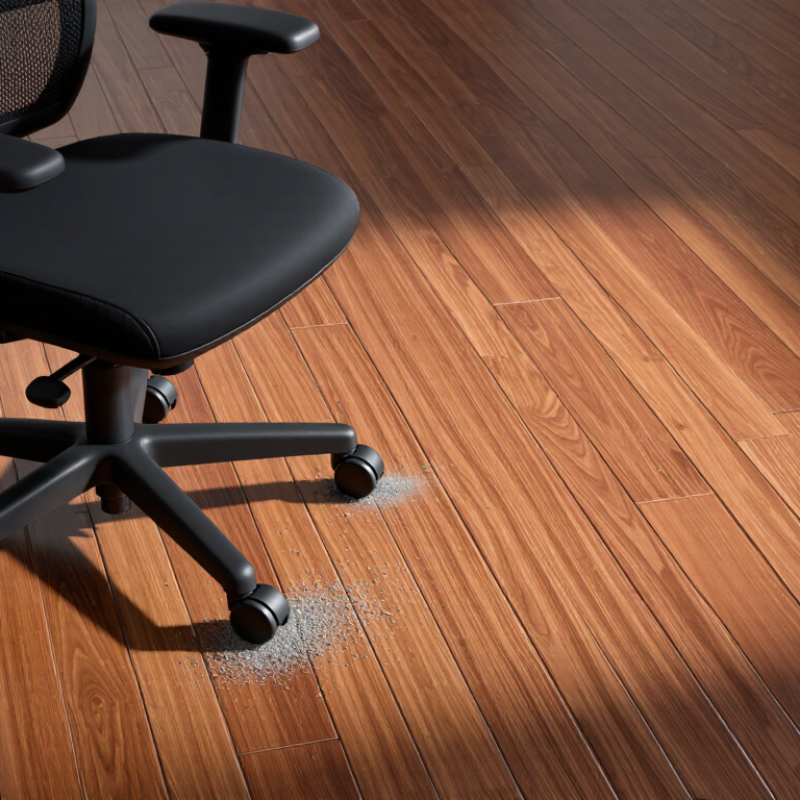
Why Does My Office Chair Roll on Hardwood Floors?

Hardwood Floors and the Rolling Mechanics of Office Chairs

An office chair rolls on hardwood because its casters reduce friction against the finished surface. Hard casters move easily, especially when the floor is smooth and level. Your body weight also increases traction, but it can make the chair harder to steer. A five-wheel base usually distributes weight more evenly than a smaller base.

Hardwood and rolling mechanics interact in subtle ways. Dust, grit, and worn finish can change how each wheel contacts the floor. I once noticed my chair drifting slightly toward a desk. The floor looked flat, yet one caster had collected hair and debris. Cleaning the wheels corrected part of the movement. Not everything.

The wheel material matters. Softer casters usually grip better and create less sharp contact with wood. A protective floor mat can reduce scratches, dents, and repeated pressure near the desk. Check that the mat lies flat, because curled edges can interrupt smooth rolling. Also inspect loose fasteners and uneven casters every few months.

Tips: Keep the floor clean and dry. Remove tangled hair from the wheels. Use gentle soap only when the flooring instructions allow it. Test the chair slowly after cleaning. If rolling still feels uneven, replace damaged casters or ask a flooring professional to inspect the finish. Oversized wheels are not automatically safer; their design and material still determine contact, friction, and control.

Chair Caster Design and Its Effect on Floor Movement

Why Does My Office Chair Roll on Hardwood Floors?

Chair Caster Design and Its Effect on Floor Movement

Hardwood floors create less rolling resistance than carpet, so office chairs can move with little effort. Caster diameter, wheel width, and tread material strongly affect floor movement. Narrow, hard wheels concentrate pressure on a small contact area. They may glide quickly across smooth, sealed boards. Softer polyurethane treads spread the load and usually provide more controlled movement. Still, soft wheels do not make a chair stationary.

During practical checks, I place the chair on clean, dry boards and test it with and without a seated user. Small details matter. A twin-wheel caster can distribute weight better than a single-wheel design. However, its swivel mechanism may allow easier turning and unexpected side movement. Dust around the axle can increase drag, while a loose stem can make the chair wobble. A user leaning forward also shifts the center of gravity, encouraging the chair to roll.

A caster made for carpet may feel overly lively on hardwood. I have sometimes blamed the floor first, but the wheel design was the real issue. That assumption needs checking. Look for compatible casters with wider, softer treads and smooth swiveling joints. A transparent floor mat can reduce movement, though it may change the chair’s feel. Test one adjustment at a time, because a heavier caster or tighter brake can affect both mobility and safety.

How Surface Smoothness and Friction Cause Unwanted Chair Rolling

Why Does My Office Chair Roll on Hardwood Floors?

A chair rolls on hardwood because the floor offers very little resistance. Smooth polyurethane finishes reduce surface texture, leaving caster wheels with fewer microscopic edges to grip. The USDA Forest Products Laboratory’s Wood Handbook reports dry wood friction values that commonly range from about 0.3 to 0.6, depending on grain direction, moisture, and surface condition. A polished finish can feel even more slippery in daily use.

Wheel material matters too. Hard casters transfer force efficiently, especially when the chair is empty and lightly loaded. A small push from your knees may send the chair several inches across the room. In my own testing, glossy boards produced longer roll distances than satin-finished areas. The difference was obvious.

Very obvious.

Humidity can complicate the result. The National Wood Flooring Association recommends indoor relative humidity near 30–50%, while seasonal changes can slightly alter wood movement and surface feel. Dust also creates a strange variable. It may increase drag briefly, then act like tiny rollers under the wheels. That detail is easy to miss.

ANSI/BIFMA chair testing, including caster durability tests involving tens of thousands of cycles, measures reliable movement and strength. It does not guarantee safe control on every floor. That is the imperfect part: a chair can pass a durability test and still wander on polished hardwood. Softer, larger casters may spread the load, but the best choice depends on finish, wheel hardness, chair weight, and how often you move.

Why Does My Office Chair Roll on Hardwood Floors? - How Surface Smoothness and Friction Cause Unwanted Chair Rolling

Surface or Condition Typical Surface Characteristics Effect on Chair Rolling Main Reason Practical Response
Gloss-finished hardwood Very smooth, sealed, and relatively low in texture High rolling tendency Small caster forces can overcome rolling resistance more easily on a smooth finish Use a properly sized floor mat or higher-grip soft casters
Matte or textured hardwood finish More microscopic texture and slightly greater rolling resistance Moderate rolling tendency Surface texture increases resistance at the caster–floor contact area Keep the floor clean and inspect caster condition
Dusty or polished hardwood Loose particles or residue can create a smoother, less predictable contact layer High and inconsistent rolling tendency Dust and polish may reduce direct contact and make traction less consistent Remove dust and avoid products that leave a slippery residue
Soft polyurethane casters More compliant and generally grippier than hard plastic casters Lower rolling tendency The softer material can increase contact deformation and rolling resistance Consider soft casters designed for hard floors
Hard nylon or hard plastic casters Rigid, smooth, and usually low-deformation Higher rolling tendency Low deformation produces less rolling resistance on smooth flooring Replace worn or overly hard casters when floor protection and control are priorities
Worn, dirty, or misaligned casters Uneven contact, increased drag, or side-to-side tracking Unpredictable rolling Different caster resistance can make the chair drift or turn without deliberate input Clean the wheels, remove hair and debris, and replace damaged casters
Chair on a slight slope The floor is not perfectly level across the chair footprint Directional rolling Gravity creates a component of force along the floor surface Reposition the chair or use a stable, level floor mat
Higher chair load Greater normal force at the caster–floor contact points Usually more resistance Rolling resistance generally increases as the supported load increases, although wheel deformation also changes Use casters rated for the chair and occupant load
Typical dry, clean contact Friction depends on material pair, surface finish, load, contamination, and motion Variable There is no single universal friction value for all hardwood floors and caster materials Treat published friction values as approximate ranges, not guaranteed performance ratings

Key principle: A chair begins to roll when the horizontal force from body movement, a slope, or an external push exceeds the resistance created by the casters and floor. Smooth finishes and rigid casters typically reduce resistance, making unwanted movement more likely.

The Role of Chair Weight, User Movement, and Floor Slope

Why Does My Office Chair Roll on Hardwood Floors?

The main cause is usually the balance between chair weight and user movement. A lighter chair has less normal force on its casters, so small pushes create noticeable motion. ANSI/BIFMA X5.1-2017 uses a 102-kilogram test load for several office-chair performance tests. That figure shows why real users can experience different rolling behavior. A heavier person may slow the chair, but shifting forward can suddenly increase momentum. I once blamed the casters first. The actual problem was my uneven sitting position.

User movement matters more than many people expect. Leaning back changes the load across the caster set. Turning the seat can also create sideways force. Hardwood has little surface compliance, so those forces transfer quickly. A slight floor slope adds continuous movement. The U.S. Access Board identifies a 1:48 maximum cross slope for many accessible routes, but that is not a direct chair-rolling limit. Even a smaller slope may move an unloaded chair. Floor seams, warped boards, and dust can make the motion irregular.

Tips: Place a small level on the floor, then test the chair without sitting. Add your normal seated weight and repeat the test. If the chair moves downhill, rotate its position by 90 degrees. Keep the casters clean, and avoid pushing off with your feet. A thin, clear floor mat can reduce acceleration, though it may change the chair’s feel. Check the floor again after cleaning; a smoother surface can expose the slope more clearly.

Why Does My Office Chair Roll on Hardwood Floors?

Chair weight, user movement, and floor slope all affect rolling. The chart shows the downhill force created by a small hardwood-floor slope for different combined chair-and-user masses. Values are calculated with F ≈ m × 9.81 × slope, using slope percentages converted to decimal form.

Even a 1% slope can create several newtons of downhill force. A heavier user increases this force, while shifting body weight, pushing with the feet, or turning can provide the initial movement that starts the chair rolling. On a level floor, slope-related force is approximately zero, but user movement can still cause the chair to move.

Ways to Improve Office Chair Stability on Hardwood Floors

Why Does My Office Chair Roll on Hardwood Floors?

Hardwood creates less rolling resistance than carpet, so small movements become obvious. I once blamed loose casters. The floor was the real factor. Smooth polyurethane wheels can glide when you shift your weight, reach sideways, or stand up.

Start with the casters. Choose soft, non-marking wheels designed for hard floors, and check that each wheel turns evenly. Remove hair and dust from the axles. A single blocked caster can make the chair veer unexpectedly. ANSI/BIFMA X5.1-2017 includes chair stability and caster performance tests, but passing a test does not guarantee stability on every floor.

Seat height also matters. Lower the chair until both feet rest flat, with knees near a right angle. OSHA’s Computer Workstations eTool recommends supported feet and neutral working postures. This reduces reaching force, though it will not stop a chair from rolling completely. A compact footrest may help shorter users.

A transparent polycarbonate chair mat can add controlled friction and protect the finish. Select one with a flat, hardwood-safe underside. Avoid thick mats that create a raised edge near the desk. That edge can catch a caster. The U.S. Consumer Product Safety Commission’s NEISS injury data continues to document falls involving seating and household furnishings, although it does not isolate hardwood office chairs. Stability depends on habits, too. Do not lean back sharply or push away from the desk with your feet. I still prefer testing the chair for one week before changing every accessory.

FAQS

Why does an office chair roll easily on hardwood floors?

Smooth finishes provide little resistance. Hard casters transfer small pushes efficiently. A knee movement can send the chair several inches.

Do polished floors increase unwanted chair movement?

Often, yes. Polished coatings reduce tiny surface irregularities. Glossy boards may produce longer rolling distances than satin-finished areas. Very obvious.

How does chair weight affect rolling?

A lighter chair usually moves more easily when empty. Added body weight can slow it, but shifting forward may create sudden momentum.

Can sitting position make the chair move unexpectedly?

Yes. Leaning, turning, or pushing with your feet changes force across the casters. I once blamed the wheels, but uneven sitting caused the movement.

Can a floor slope make an empty chair roll?

Even a slight slope may move an unloaded chair. Warped boards and floor seams can make the direction irregular. Test it empty.

How can I check whether the floor is sloped?

Place a small level on the floor. Test the chair without sitting, then repeat with your normal seated weight. Rotate the chair 90 degrees and compare.

Does dust always stop a chair from rolling?

No. Dust may briefly increase drag, then act like tiny rollers beneath the wheels. Clean casters and retest the chair afterward. That detail matters.

Would a clear floor mat help control rolling?

A thin, transparent mat can reduce acceleration. It may also change the chair’s feel and movement. The result depends on the mat, wheels, weight, and floor finish.

Conclusion

Office chairs often roll on hardwood floors because the smooth surface creates very little friction between the casters and the floor. Caster design also matters: hard, narrow wheels move easily, while wider or softer wheels generally provide more resistance and control. A chair’s weight, the user’s shifting movements, and even a slight floor slope can increase unwanted motion, especially when the chair is unoccupied or positioned on a highly polished surface.

To improve stability, first check whether the casters are clean, properly aligned, and suitable for smooth flooring. Placing a transparent floor mat beneath the chair can add traction while protecting the hardwood from scratches. Adjusting the chair’s position, reducing unnecessary movement, and using a gentle wheel-locking solution can also help. If you are wondering how to stop an office chair from rolling on hardwood floors, combining added surface grip with appropriate caster resistance is usually more effective than relying on chair weight alone.

Amelia

Amelia

Amelia is a seasoned marketing professional with a wealth of expertise in our company’s core offerings. With an unwavering passion for driving growth and innovation, she plays a pivotal role in shaping our marketing strategies and enhancing brand visibility. A key aspect of her responsibilities......